
Choosing a custom stainless steel pendant manufacturer is not only a design decision. A pendant that looks correct in a rendering can still fail in production if the weight, bail opening, chain size, edge finish, plating color or logo position is not defined before sampling. For brands, wholesalers and importers, the safest RFQ is one that turns the visual idea into measurable specifications.
This guide explains how to prepare those specifications, compare samples and control bulk production. It is written for B2B buyers developing private-label pendants, adding new designs to a wholesale collection or adapting an existing concept for stainless steel production.
What a Custom Pendant Manufacturer Should Be Able to Control
A capable OEM partner should help convert an image, sketch or reference sample into a production-ready specification. The work may include 2D drawing review, 3D modeling, prototype development, mold or tooling preparation, polishing, stone setting, enamel, laser engraving, plating, assembly and packaging. Not every design needs every process, but the supplier should explain which route suits the shape and expected order volume.
The first conversation should establish whether you need a pendant component only or a complete necklace. A complete necklace introduces more variables: chain style, wire diameter, finished length, extension chain, clasp, jump rings and the inner dimensions of the bail. Buyers can review GZN’s stainless steel pendant collection and separate men's pendant wholesale range and women's pendant wholesale range before preparing a custom brief.
A useful manufacturer response should identify unclear details instead of pricing an incomplete picture. If two suppliers quote different assumptions, the lower number may not represent the same product.
Start With the Product Specification, Not Only the Artwork

Artwork communicates appearance; a specification controls production. Include front, back and side views whenever possible. Mark the overall height and width, maximum thickness, bail opening, logo location and any recessed or raised areas. If weight is commercially important, give a target range rather than asking for a vague “heavy feel.”
The following details prevent the most common misunderstandings:
- Finished pendant dimensions, excluding and including the bail
- Target weight or acceptable weight range
- Solid, hollow or partially hollow construction
- Base material grade and any market-specific material requirement
- Front, back and side surface finish
- Bail type, inner dimensions and assembly method
- Chain type, gauge, length, clasp and extension, if included
- Stone type, size, color, setting method or enamel reference
- Logo method, size, depth and exact position
- Finish color, gloss level and approved physical color sample
- Individual packaging, barcode, warning label and carton requirements
Keep a version number and date on the approved specification. During revisions, this simple control stops an older drawing from returning to the production line.
316L or 304 Stainless Steel for Pendants?
Both grades are used in commercial products, but they should not be treated as interchangeable without buyer approval. The correct choice depends on design, target market, finish, testing plan and cost position. For a detailed sourcing comparison, see the 316L versus 304 stainless steel jewelry guide.
Many jewelry buyers specify 316L for products intended for regular skin contact and for programs that require tighter material control. However, the grade name alone is not proof of compliance or final product performance. Ask how the supplier verifies incoming material and how the finished item will be tested for the destination market. Plating, solder, stones, adhesives and other components must also be considered; testing only the main pendant body may not represent the complete necklace.
Avoid unsupported absolute claims such as “allergy-free” in product marketing. Material composition, individual sensitivity, coatings and legal requirements vary. Build claims around documented specifications and suitable test reports.
Match the Manufacturing Method to the Design
Different pendant forms require different production routes. A flat logo plate may be laser cut, stamped or machined. A sculptural lion, skull or religious figure may require 3D modeling and casting. A geometric pendant with controlled planes may use machining and polishing before plating. The manufacturer should recommend the process after reviewing geometry, undercuts, detail depth, order quantity and target price.
Ask these questions before approving tooling:
- Which details may become softer or sharper after polishing?
- Where will parting lines, gates or assembly marks appear?
- Can recessed areas be polished and plated consistently?
- Is the back solid, hollowed or closed with a separate component?
- Which dimensions may change after finishing?
- Can the logo remain legible at the proposed depth and size?
Complexity is not automatically a problem. Uncontrolled complexity is. A manufacturable drawing should preserve the design identity while removing details that cannot be repeated consistently in bulk.
Weight, Thickness and Wearability Must Be Balanced
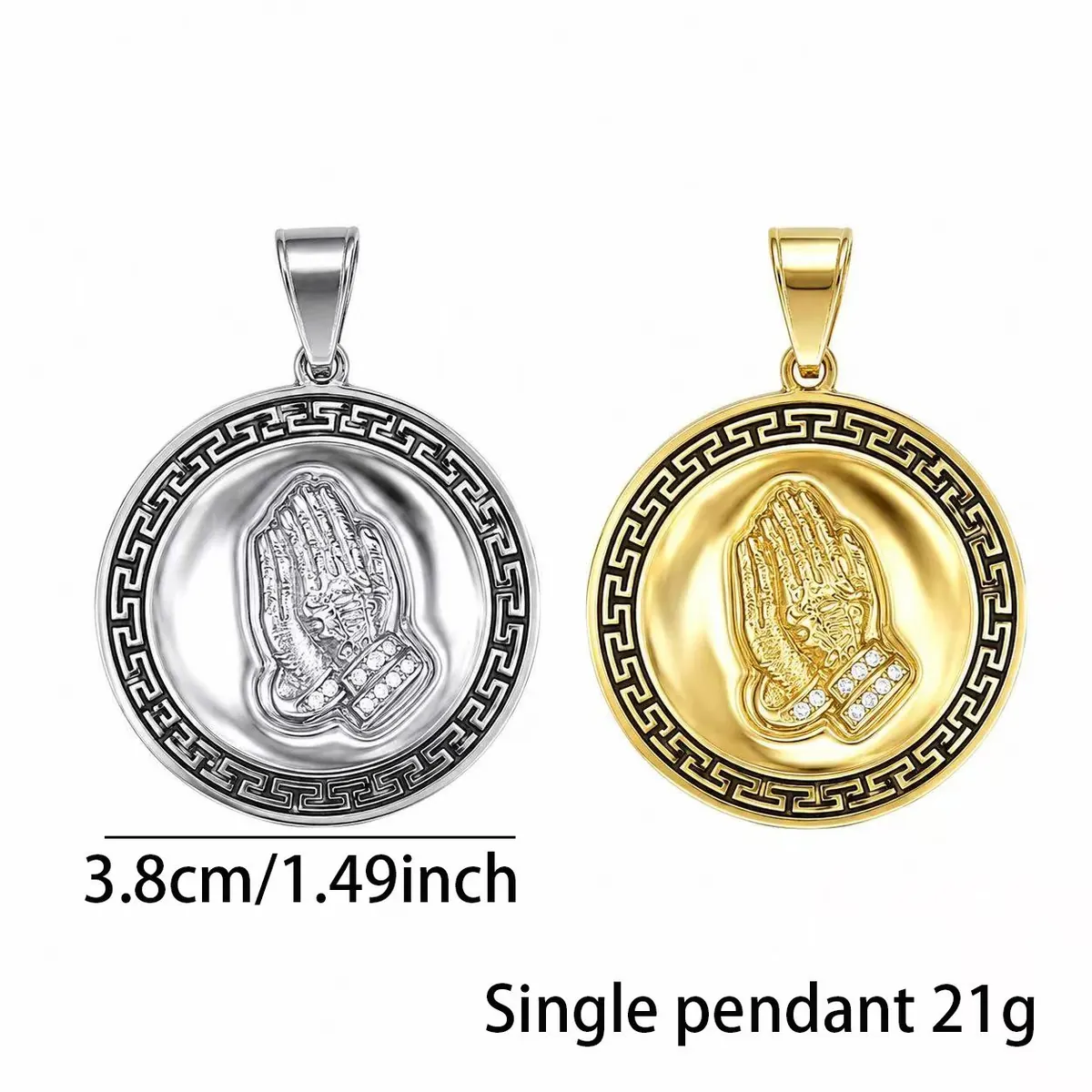
Pendant weight affects perceived value, shipping cost, chain selection and comfort. A heavy pendant on a light chain can pull awkwardly, damage connecting rings or create an unbalanced appearance. A very thin pendant may feel inexpensive or distort during handling. The specification should therefore treat pendant body, bail, jump ring and chain as one system.
For each sample, record actual weight and critical dimensions. Do not rely only on a supplier’s reference photograph. A useful sample report compares target and actual measurements and notes any approved tolerance. When a design is intentionally hollowed to reduce weight, inspect the back construction and edges so the cost reduction does not create a weak or unfinished product.
The Praying Hands CZ stainless steel pendant shows why front detail, back construction and size references should be reviewed together. Three-dimensional products such as the St. Michael guardian bell pendant also require the buyer to define whether moving or assembled parts are functional or decorative.
Design the Bail and Chain Together
The bail is a small component with a large effect on returns and customer satisfaction. Its internal opening must accommodate the chain or connector, including any end cap that must pass through it during assembly. The bail also needs enough clearance for the pendant to hang correctly without excessive movement.
Confirm whether the bail is fixed, hinged, hidden, cast as part of the pendant or attached with a jump ring. Ask for its inner height and width, wire or wall thickness and closure method. For complete necklaces, approve the exact production chain rather than a temporary sample chain. Chain style and gauge can alter the visual scale of the whole piece.
For retail programs offering several chain lengths, verify every variation. A pendant that works on a short curb chain may not sit the same way on a longer rope or box chain.
Control Polishing, PVD Color, Enamel and Stones
Surface finishing changes the character of the design. Mirror polish, brushed finish, sandblasting, blackened recesses and antique effects highlight different features. Mark each surface on the drawing, especially when one pendant combines finishes.
For gold, black or other PVD colors, approve a physical sample under consistent lighting. Color names alone are not precise enough for bulk approval. Record the approved sample code, base surface, gloss level and any areas that must remain unplated. Discuss the intended use and target market with the supplier so the finishing and test plan can be agreed before production.
Stone-set and enamel designs need additional controls. Define stone dimensions, color reference, setting pattern, acceptable orientation and replacement policy. For enamel, approve fill height, boundary cleanliness and color under normal light. The Medusa head stainless steel pendant is an example of a design where relief, recessed contrast and polishing must work together rather than be inspected separately.
Use a Two-Stage Sample Approval
For a new custom design, separate structural approval from finish approval when practical. The first stage checks dimensions, weight, relief, bail, logo and assembly. The second stage checks plating color, polishing, stones, enamel and packaging. This prevents buyers from approving an attractive finish on a structure that is still incorrect.
Create a signed or digitally confirmed approval record containing:
- Drawing and specification version
- Sample photographs from multiple angles
- Actual dimensions and weight
- Material and component list
- Approved color or finish reference
- Logo and packaging confirmation
- Deviations accepted by the buyer
- Date and responsible contact
The approved sample should become the comparison standard for bulk inspection. If a pre-production sample changes after approval, record the change and request confirmation again.
What Determines MOQ, Unit Cost and Lead Time?
There is no responsible universal MOQ for every custom pendant. MOQ depends on tooling, process, material procurement, plating batch, stone or enamel requirements, packaging and the number of variations. A simple engraved stock shape may have a different threshold from a new sculptural design requiring custom tooling.
Unit cost is also influenced by weight, machining time, polishing difficulty, component count, stone setting, finish, packaging and inspection. Ask suppliers to separate one-time charges from repeat-order unit pricing. Where useful, request price breaks at realistic quantities, but do not inflate the forecast only to obtain an attractive quotation.
Lead time should be divided into design review, sample or tooling, sample approval, material preparation, bulk production, inspection and shipping. The production clock cannot start accurately while artwork, color, packaging or payment terms remain unresolved. A good quotation states what information is still pending.
GZN’s OEM and ODM manufacturing service can be used to discuss the process for a specific concept. Final MOQ, price and schedule should be confirmed against the approved specification, not assumed from a general guide.
Bulk Quality-Control Checklist
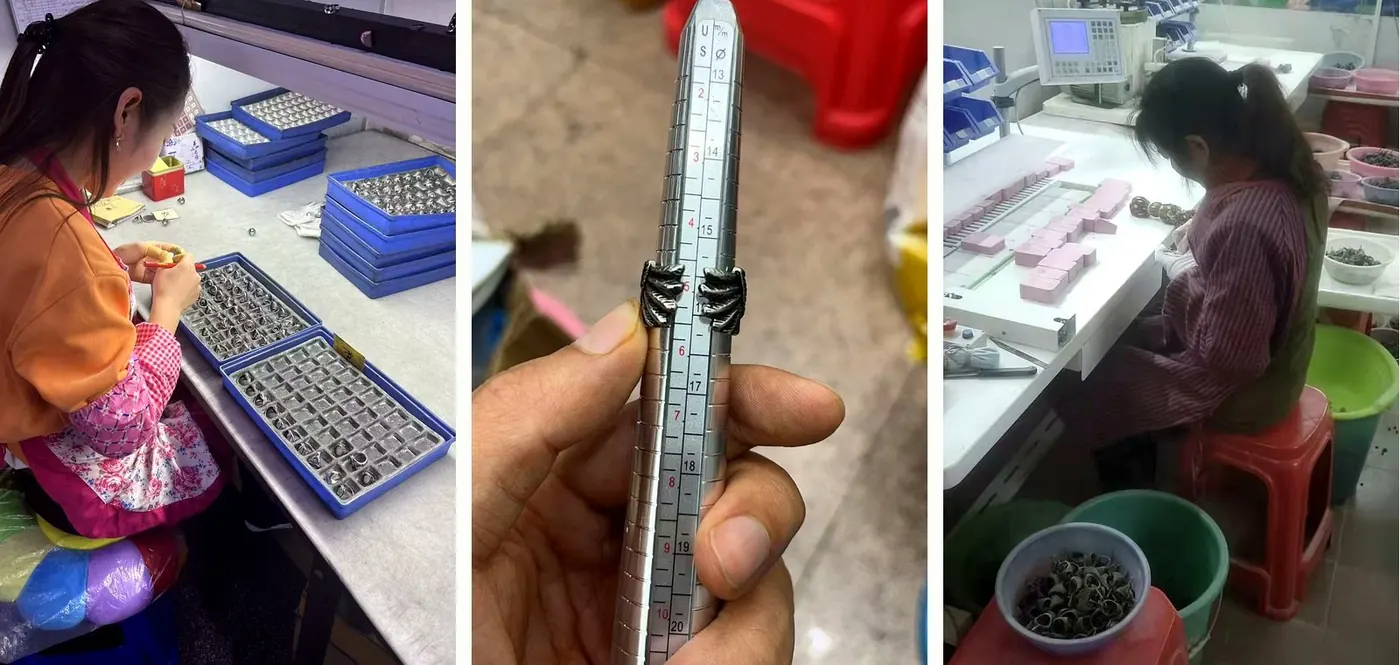
Quality control should follow the approved sample and written tolerances. Random visual inspection alone is not enough for a product combining pendant, bail, chain, plating and packaging.
| Inspection area | What the buyer should define |
|---|---|
| Material | Required grade, components covered and verification method |
| Dimensions | Critical dimensions, measuring points and tolerance |
| Weight | Target or approved range for pendant and complete necklace |
| Surface | Polish direction, scratches, pits, sharp edges and residue |
| Color | Approved physical reference, finish and acceptable variation |
| Bail and rings | Opening, alignment, closure and assembly strength |
| Stones or enamel | Color, position, security, fill and surface cleanliness |
| Logo | Method, size, depth, orientation and legibility |
| Chain and clasp | Style, gauge, length, function and connection |
| Packaging | Correct SKU, labels, barcode, quantity and protection |
Review the factory tour and quality-control process to understand the checkpoints that can be discussed with the production team. For regulated markets or buyer-specific restricted substance requirements, plan testing around the complete product and consult the jewelry RSL and compliance guide. Test scope and acceptance criteria should be agreed before the order, not added after goods are complete.
RFQ Template for a Custom Stainless Steel Pendant
An efficient RFQ gives every shortlisted supplier the same information. Use the following checklist:
- Buyer company, destination market and intended sales channel
- Design files, reference images and ownership confirmation
- Pendant dimensions, target weight and construction
- Material grade and compliance or testing requirements
- Bail, chain, clasp and necklace length specifications
- Surface finish, PVD color, enamel and stone details
- Logo, hangtag, barcode and private-label packaging
- Sample quantity and approval deadline
- Estimated first order and repeat-order forecast
- Required trade term, delivery location and target date
Ask the quotation to show tooling or development charges, sample cost, unit price basis, packaging assumptions, production lead time, payment terms and quotation validity. If you are comparing EXW, FCA, FOB or DAP offers, confirm exactly which transport, export, import and tax responsibilities are included. Incoterms affect logistics responsibility; they do not replace the product specification.
How to Compare Pendant Manufacturers
Compare evidence, communication and repeatability, not only the first quoted price. A useful supplier asks technical questions, identifies risk before tooling and can explain how the approved sample will be controlled in production. Warning signs include a quotation issued from one photograph with no specification questions, unexplained material substitutions, refusal to record sample revisions or vague answers about inspection.
Request examples relevant to your design category, but protect your own intellectual property and respect other brands’ confidentiality. Factory images and sample references can support due diligence, yet a structured development process is more valuable than a large gallery alone.
Start with a controlled project whose design, sample and inspection criteria can be documented. After delivery, record defects, packaging issues and customer feedback. That information improves the next order and helps determine whether the manufacturer is suitable for a larger collection.
Frequently Asked Questions
Can a manufacturer quote from a photo?
A photo can support an initial estimate, but a final quotation should be based on dimensions, construction, material, finish, components, logo, packaging and quantity. Otherwise, suppliers may be pricing different assumptions.
Should I order the pendant and chain from the same supplier?
It is often easier to control fit and assembly when one supplier delivers the complete necklace. If components come from different sources, provide physical samples or exact dimensions and test the final combination before bulk production.
Is 316L always required?
Not every market or product program uses the same requirement. Select the material according to target market, product use, buyer specification, finish and testing plan. Do not allow a grade change without written approval.
When should compliance testing be arranged?
Define the test requirement before sampling and confirm the final test scope before bulk production. Testing late in the process creates avoidable risk if the complete product includes plating, solder, stones, adhesives or other components.
What should be approved before paying for bulk production?
Approve the current drawing, physical or pre-production sample, actual dimensions and weight, material, finish color, logo, chain and bail, packaging, inspection standard, quantity, price, lead time and trade term.
Request a Custom Pendant Review
Send your drawing, reference image, target dimensions, material, finish, quantity, destination market and packaging requirement through the GZN jewelry quotation page. The team can review whether the design is ready for sampling, identify missing specifications and prepare a project-specific quotation.
For buyers still building an assortment, begin with the wholesale stainless steel pendant collection and use the checklist above to decide which elements should remain standard and which should be customized for your brand.
Planning a broader men’s collection? Review our men’s stainless steel jewelry wholesale guide for assortment, size, chain, MOQ, packaging and category-specific QC decisions.