
For a jewelry brand or wholesaler, choosing between PVD and electroplating is not simply a choice between a premium finish and a budget finish. The useful question is whether a specific coating system can deliver the appearance, wear performance and consistency your collection requires.
A process name is not a finished-product specification. Two gold-tone rings can differ in their base metal, underlayers, actual gold content, coating thickness and surface preparation, even when their product descriptions sound similar.
This guide compares wet electroplating with vacuum PVD, using recent research and published technical specifications to explain what buyers should check. External research results and manufacturer specifications cited here are not test results or certifications for GZN products.
What Is the Difference Between Electroplating and PVD?
Wet electroplating uses an electrical circuit and an electrolyte containing dissolved metal ions to deposit a coating on a component. This is the process often called "water plating" in supplier conversations; the technical term to use in a purchase specification is electroplating. It is different from water-transfer printing, paint or an electrophoretic clear coat. Bodycote technical glossary
Vacuum coating is a broader description. Here, PVD means physical vapor deposition, including processes such as magnetron sputtering and cathodic arc deposition. Decorative PVD systems can use materials such as titanium nitride (TiN) or zirconium nitride (ZrN), not just precious metals. A gold-colored PVD coating therefore does not, by itself, prove that the coating contains gold. Ionbond PVD technology, decorative coating materials
| Purchasing question | Wet electroplating | Vacuum PVD |
|---|---|---|
| Where is the coating deposited? | In an electrolyte bath | In a vacuum chamber |
| What must the specification identify? | Deposit composition, underlayers and top layer | Coating materials, functional layers and any precious-metal top layer |
| What does "thickness" mean? | State the layer being measured and the measurement locations | Separate total film thickness from the thickness of any actual gold layer |
| How should appearance be approved? | A retained color sample, gloss and surface-finish standard | The same: "PVD gold" alone is not a color standard |
| What needs attention on a complex design? | Local coverage, underlayers and preparation | Fixturing, masking, recesses and hidden surfaces |
| What makes a quotation comparable? | The same SKU, quantity and acceptance requirements | The same SKU, quantity and acceptance requirements |
Ionbond describes decorative PVD as a line-of-sight process with limited coverage of hidden features and deep recesses. For an engraved ring, chain or pendant, make the inside surfaces and recessed areas part of sample approval, not just the front face. Decobond technical information
Coating Thickness and Hardness: Read the Specification First
The following are examples of two commercial systems. They are not industry averages or a matched durability experiment.
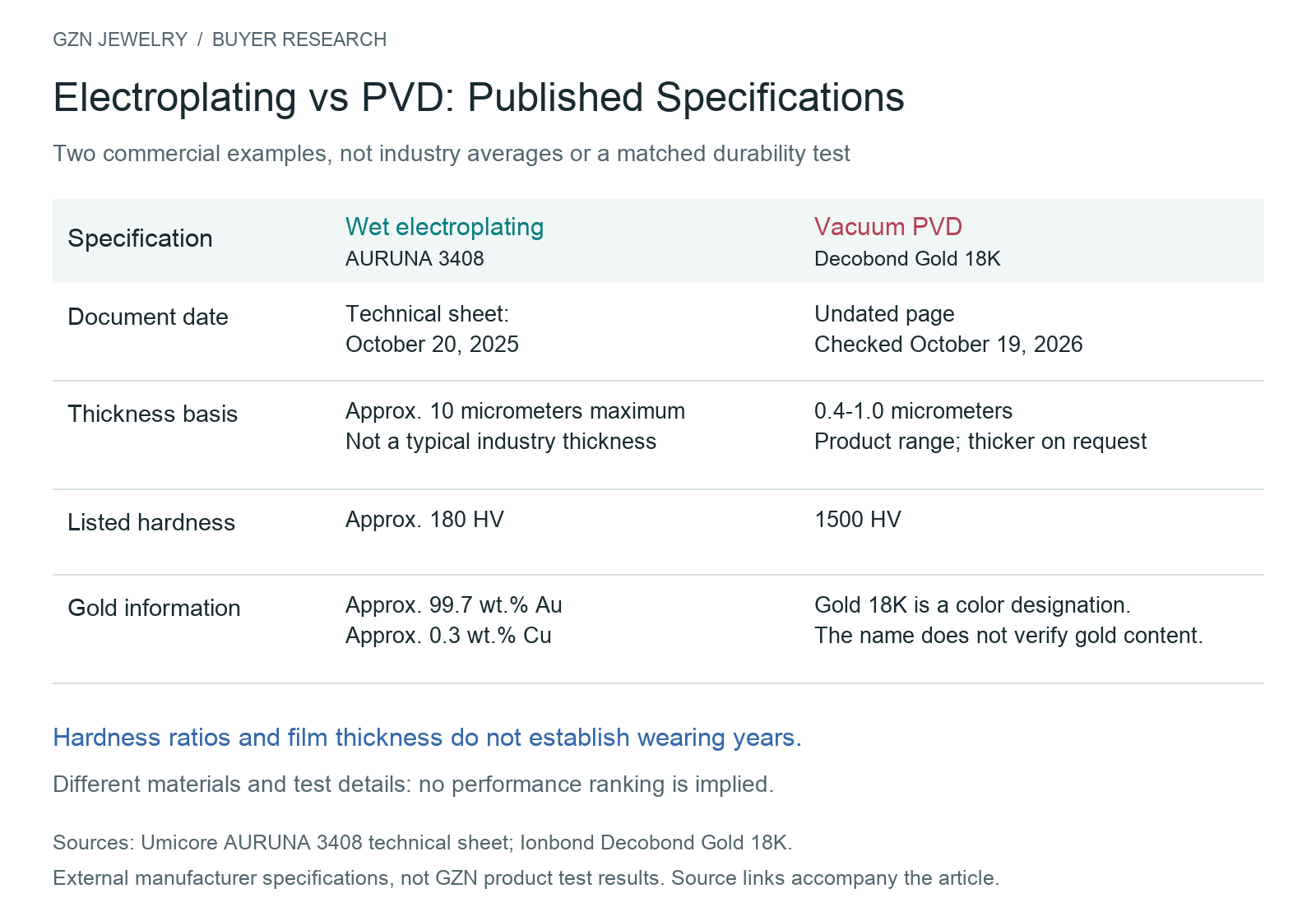
| Published specification | Electroplating example: AURUNA 3408 | PVD example: Decobond Gold 18K |
|---|---|---|
| Document date | Technical sheet dated October 20, 2025 | Page undated; checked October 19, 2026 |
| Composition or designation | Approximately 99.7 wt.% Au and 0.3 wt.% Cu | Gold 18K color designation; gold content cannot be inferred from the name |
| Thickness | Approximately 10 micrometers maximum for the specified electrolyte | 0.4-1.0 micrometers; thicker coatings on request |
| Listed hardness | Approximately 180 HV | 1500 HV |
Sources: Umicore AURUNA 3408 technical sheet and Ionbond Decobond Gold 18K.
A maximum deposit capability is not an average production thickness. These systems also differ in material and test details. Dividing their hardness figures would not establish a wear-life multiplier or a number of years the jewelry will retain its color.
When comparing two "1-micron" quotations, ask whether each figure refers to the gold-containing top layer or the entire coating stack. Without that distinction, the numbers may describe different things.
What a 2024 Study Found About Nickel Release
A 2024 study in Heliyon tested treated 316L stainless steel using EN 1811:2023. Three selected systems illustrate why the coating structure matters. Original research
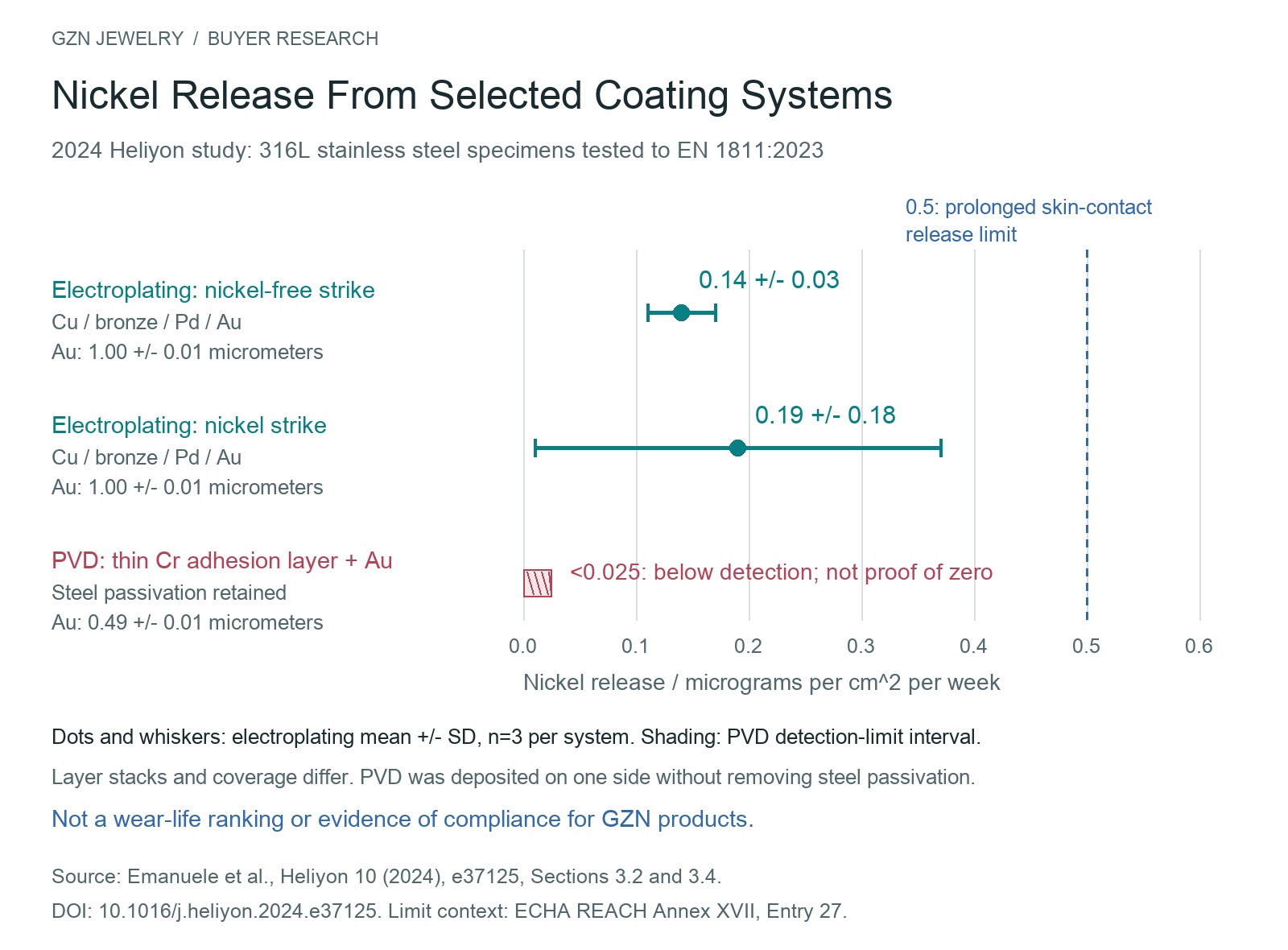
| Experimental system | Gold thickness | Nickel release, micrograms/cm²/week |
|---|---|---|
| Polished 316L, nickel-free AURINOX strike, Cu/bronze/Pd/Au electroplating | 1.00 ± 0.01 micrometers | 0.14 ± 0.03 |
| Polished 316L, Wood nickel strike, Cu/bronze/Pd/Au electroplating | 1.00 ± 0.01 micrometers | 0.19 ± 0.18 |
| 316L, thin chromium adhesion layer and PVD gold | 0.49 ± 0.01 micrometers | Below 0.025, the detection limit |
Electroplating release values are means ± standard deviations for three specimens per system. The PVD process retained the steel's passive layer and coated only one side. These are different layer structures and coverage arrangements, not an identical-stack comparison. Below the detection limit does not mean zero; nickel release is not a wear or color-retention test.
For purchasing, a nickel-free plating bath or strike should not replace testing the finished article, particularly when the substrate itself contains nickel.
EU REACH Annex XVII Entry 27 sets a nickel-release limit of 0.5 micrograms/cm²/week for relevant parts in direct and prolonged skin contact; piercing post assemblies must release less than 0.2 micrograms/cm²/week. Relevant non-nickel coatings must maintain the specified release control for at least two years of normal use. That requirement is not a two-year color warranty. Have a laboratory confirm the applicable method, pretreatment and conformity decision for the finished item. ECHA restriction text
A 2025 Study Combined Electroplating With a Vacuum-Deposited Protective Film
The two processes do not always have to be alternatives. A December 2025 study in Current Applied Physics electroplated gold onto silver, then added AlN/SiO₂/AlN protective multilayers by reactive magnetron sputtering. Its abstract reports a nanoindentation hardness of 7.02 ± 0.62 GPa, a color difference of ΔE < 5 for the specimen with a 110-minute SiO₂ deposition, and no visible discoloration of multilayer-coated specimens after 240 days of ambient exposure. Publisher abstract
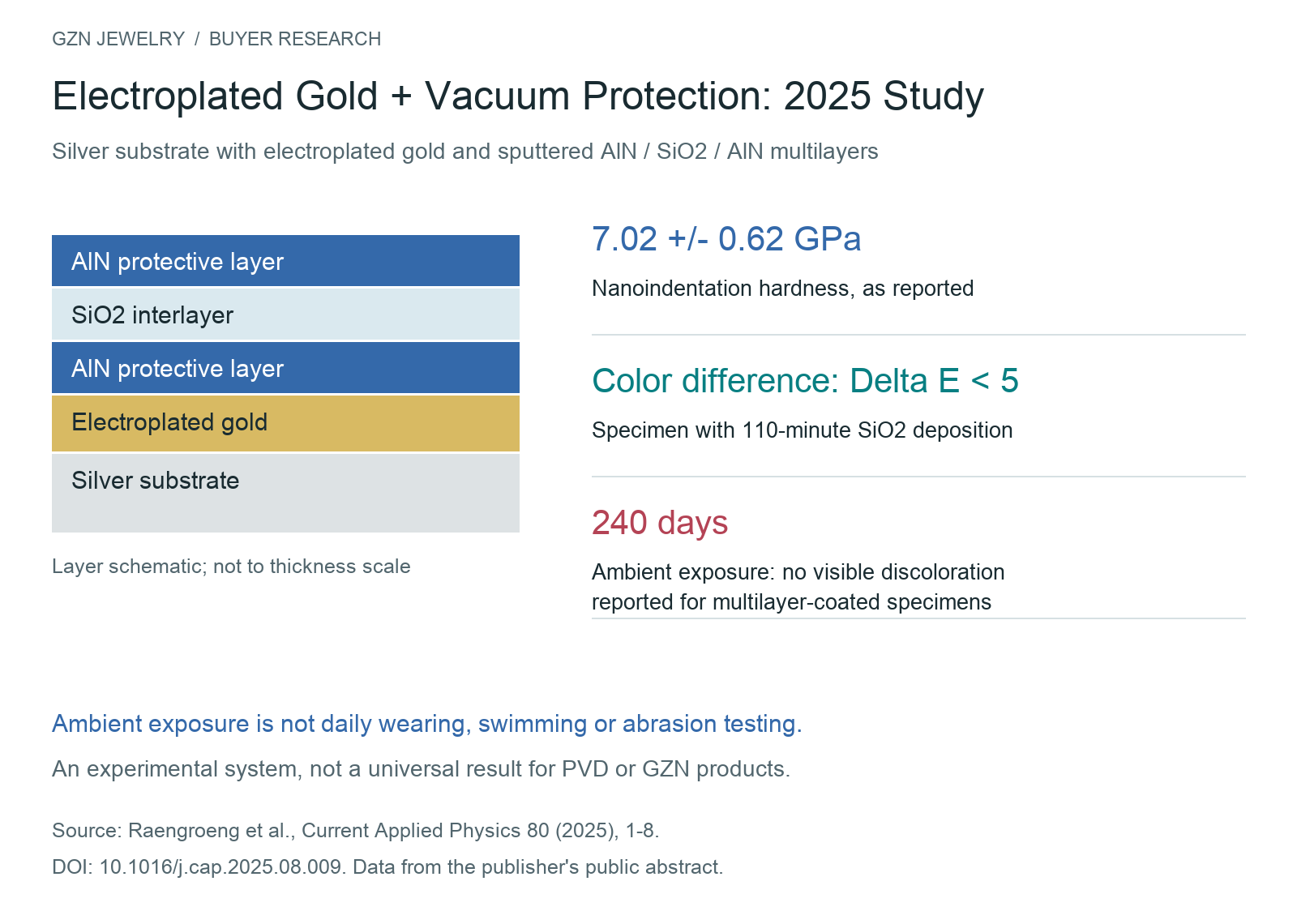
Those results apply to that experimental system. Ambient exposure is not daily wearing, swimming or an abrasion test, and the study does not establish that an ordinary supplier can reproduce the same performance in production. For a project that needs an actual gold layer, it offers a direction for sample development rather than a universal product claim.
Color Retention, Abrasion and Water Exposure Need Separate Checks
Build the acceptance plan around the ways your jewelry might fail: exposed base metal after rubbing, discoloration after sweat or chemical contact, and cracking or detachment of the coating. A single statement such as "never fades" does not define any of those requirements.
Salt-spray hours are not wearing years. ISO 9227:2022 says its salt-spray methods are not intended to rank different materials by corrosion resistance or predict long-term corrosion resistance. ASTM B117-26a also cautions against relying on salt-spray data alone to predict natural-environment performance. Neither supplies a general conversion such as "96 test hours equals two years of wear." ISO 9227, ASTM B117
Before approving claims about sweat resistance or water exposure, specify the liquid, temperature, duration, rubbing conditions and failure criteria. Tap water, chlorinated pool water, seawater and cleaning chemicals should not be treated as one interchangeable condition.
How to Compare Cost and Environmental Claims
Ask both suppliers to quote the same base material, design, quantity, approved color and acceptance requirements. A useful purchasing comparison includes the component, preparation, coating, allocated rejects and rework, testing and packaging costs. Request separate charges for sampling, fixtures and any specified precious-metal layer.
Wet chemistry is also changing. Umicore's 2025 AURUNA 3408 announcement describes a cyanide-free gold-copper electrolyte. That is a specific process option, not evidence that every electroplating line has the same chemistry or no wastewater-treatment requirements. Umicore product announcement
For PVD, review the complete route, including cleaning, any electroplated underlayers and energy use. Ionbond lists electroplating prerequisites for certain substrates in its decorative portfolio. Compare environmental information using the same product, accepted output and assessment boundaries, rather than assuming that "vacuum" proves zero pollution or a fixed emissions saving. Ionbond substrate requirements
Which Finish Should a Jewelry Buyer Evaluate?
Use the following as a sampling plan, not an untested performance guarantee.
| Project requirement | Candidate approach | Sample approval priorities |
|---|---|---|
| Gold-tone stainless steel rings or bracelets with frequent contact | Include a hard decorative PVD system and an electroplated option meeting the target specification | Inner surfaces, edges, link contact points and appearance after testing |
| Silver jewelry marketed around an actual gold layer | Define gold composition and thickness first; assess electroplating or a suitable hybrid system | The measured gold layer, underlayers, color and finished-item results |
| A specified precious-metal surface, such as rhodium | Start with the required metal and appearance, then assess the coating route | Coverage, gloss, color and consistency |
| Deep engraving, recesses or moving links | Request a coverage and fixturing proposal | Hidden surfaces, recesses and contact points |
| Glued, assembled or heat-sensitive components | Confirm processing temperature and assembly sequence | Component compatibility, attachment and function |
| A small initial collection | Compare sample costs and accepted-unit costs | Whether the approved finish can be reproduced across bulk and repeat orders |
For color references and retained samples, see the PVD gold stainless steel jewelry wholesale guide. When selecting designs from the stainless steel rings collection, make the coating specification part of the product brief, rather than a separate color note added after sampling.
What to Confirm Before a Bulk Order
| Check | What the purchase specification should record |
|---|---|
| Base material and layer structure | The material for the exact SKU, plus strike, underlayers, functional layers, any gold layer and topcoat |
| Thickness | Which layer is measured, where it is measured, and the method; confirm calibration and any necessary cross-section verification for multilayers |
| Color and gloss | A retained physical sample and agreed measurement conditions and tolerances |
| Abrasion and adhesion | Method, load, contact material, cycles where applicable, and criteria for exposed base metal or detachment |
| Sweat and corrosion | Medium, time, temperature, failure definition, and before-and-after records |
| Destination-market requirements | Finished-product test scope, applicable standards and any wear-and-corrosion pretreatment |
| Batch consistency | Sample identification, batch, sampling locations, dates and handling of deviations |
Use the quality-control overview and jewelry compliance information to prepare the questions for your project. A result from a different coating or sample should not automatically be treated as proof for every SKU in a collection.
Frequently Asked Questions
Does Gold PVD Mean Real 18K Gold?
Not necessarily. Confirm whether "18K" describes a color or a specified gold-alloy layer. If actual gold content matters to the product claim, request the composition and thickness of that layer.
Does Equal Thickness Mean Equal Durability?
No. First establish whether the thickness refers to gold alone or the complete coating. Then compare the substrate, materials, layer structure, coverage and results under the same test conditions.
Can PVD Replace Finished-Product Testing?
No. A coating supplier's specification or a published experiment can help define the purchasing brief, but it does not certify a particular ring, pendant or production batch.
Specify the Coating System, Not Just the Process Name
Electroplating and PVD use different deposition routes and offer different material options. Neither label is a substitute for a clear specification and a tested sample.
Start with the base material and intended use, define the layer structure, and validate the corresponding finished item. To discuss a GZN project, send the product links, quantities, destination market, color reference and test requirements through the contact page.
Research and Technical References
- Emanuele et al., Heliyon 10(17), e37125, 2024. Nickel release from 316L stainless steel following a Ni-free electroplating cycle. DOI: 10.1016/j.heliyon.2024.e37125. Selected data: Sections 3.2 and 3.4.
- Raengroeng et al., Current Applied Physics 80, 1-8, December 2025. AlN/SiO₂/AlN multilayer research. DOI: 10.1016/j.cap.2025.08.009. Results used here are from the publisher's public abstract.
- Umicore, AURUNA 3408 technical sheet, October 20, 2025.
- Ionbond, Decobond Gold 18K, undated page, checked October 19, 2026.
- ECHA, REACH Annex XVII Entry 27: Nickel.
- ISO, ISO 9227:2022 and 2024 amendment information; ASTM, B117-26a.