
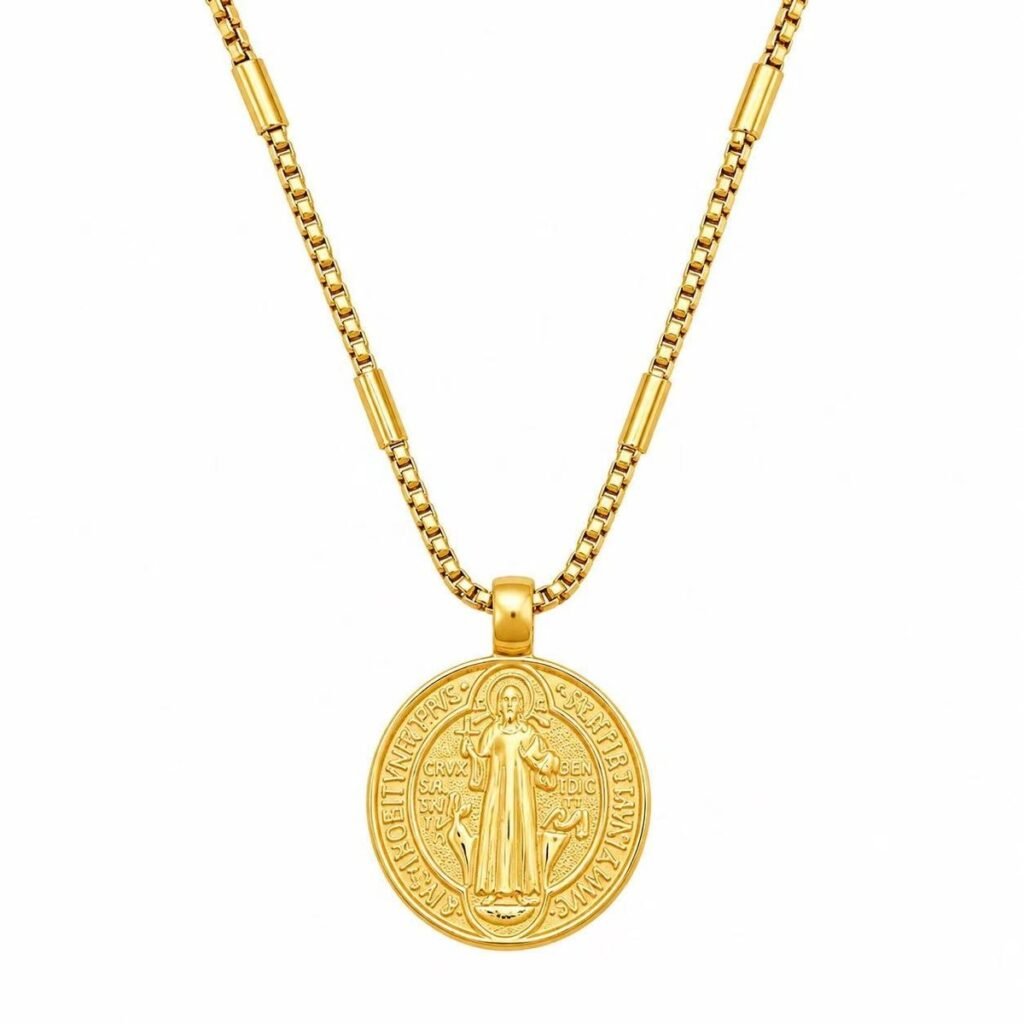
Catholic medal jewelry wholesale buying becomes easier when the collection is organized around a clear product identity instead of a general folder of crosses, saints and religious motifs. St. Benedict and St. Michael designs can both support a Catholic retail program, but they are not interchangeable. They require different artwork checks, product descriptions, assortment choices and sample approvals.
This guide is written for Catholic gift shops, religious jewelry wholesalers, church bookstores, private-label brands and importers sourcing stainless steel medals, pendants, necklaces and rings. It compares St. Benedict and St. Michael product programs from a purchasing perspective: design identity, format selection, components, finishes, MOQ, packaging and quality control.
The guide does not provide religious instruction. A jewelry factory should describe the product shown and the manufacturing service accurately, without claiming that an item is blessed, officially approved by a church authority or guaranteed to provide protection. Buyers who need a wider category plan can also review the Catholic jewelry wholesale assortment guide.
Why Separate St. Benedict and St. Michael Buying Briefs
A retailer may display both lines in one Catholic jewelry collection, but the purchase order should identify them as separate product families. A St. Benedict medal normally requires the buyer to approve two faces, small letters, orientation and the relationship between the medal and any surrounding cross or ring. A St. Michael piece requires approval of the figure, pose, attributes, border text and the exact product name used in the catalog.
Combining both into a vague brief such as “religious pendant” creates avoidable errors. The supplier may quote the wrong component, use an incomplete product title, pair a pendant with an unsuitable chain or approve a front image without checking the reverse. Separate briefs create a traceable reference for sampling, inspection, packaging and reorders.
For each family, record:
- Intended product identity and approved reference
- Front, reverse and side-view requirements
- Main-body material and connected component materials
- Finished dimensions, weight and tolerances
- Relief, lettering, oxidation and plating details
- Pendant-only or complete-necklace configuration
- Ring sizes or chain length and width
- Packaging language, labels and barcode requirements
- Sample version, approval date and bulk inspection standard
This structure also helps the retailer keep product descriptions accurate. It prevents a generic saint medal title from being reused across visually different pieces.
Understand the St. Benedict Product Architecture
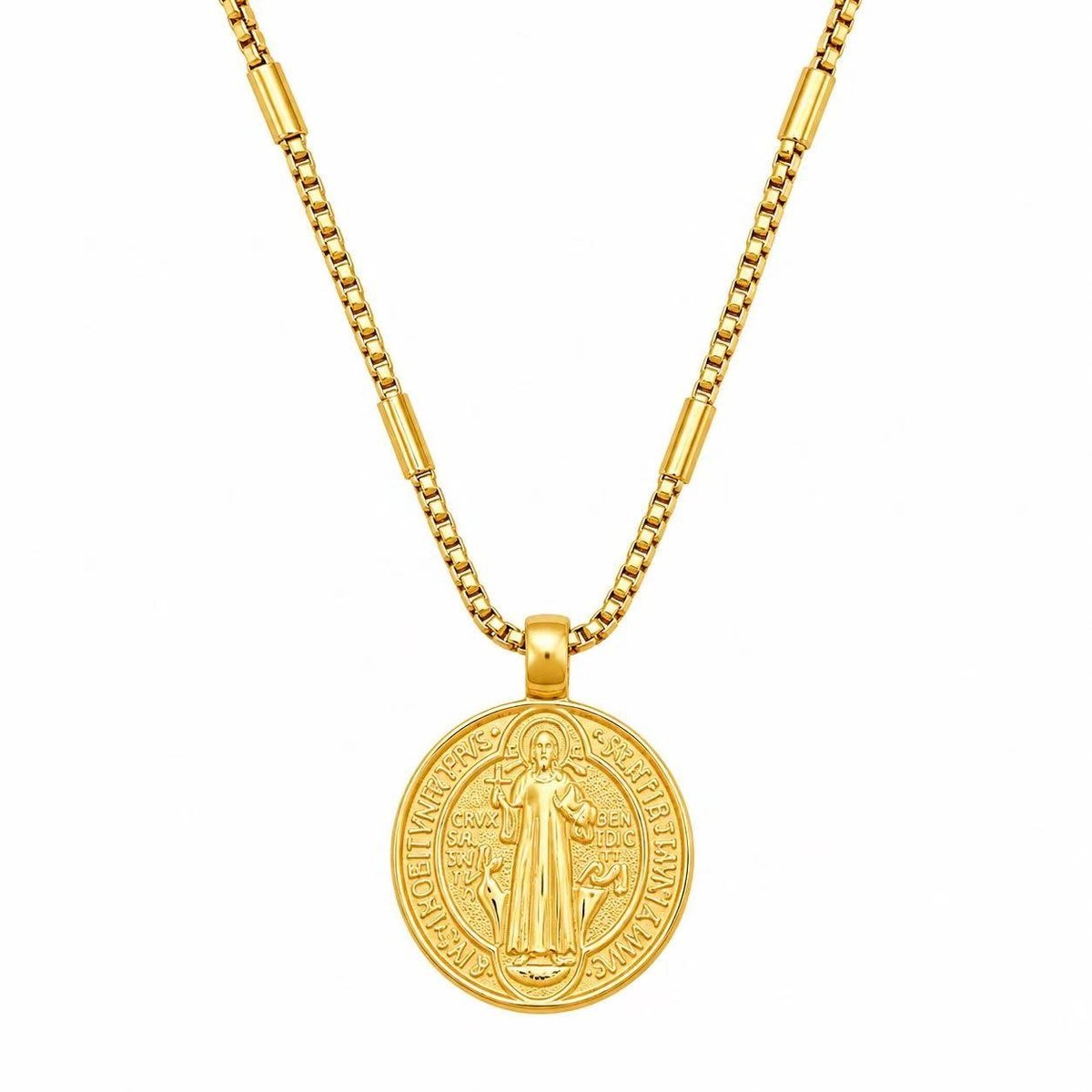
St. Benedict designs frequently contain detailed information in a small area. A buyer should treat the medal as a complete two-sided design, not as a decorative disc approved from one marketplace photograph. Request clear artwork or high-resolution product images for both faces and check the central figures, cross, initials, border inscriptions and orientation.
The St. Benedict medal and Virgin Mary pendant necklace is a useful example of a multi-component Catholic necklace. The buying decision includes the medal identity, the paired Marian component, the connecting rings, chain, clasp and final packaging. Every component needs to be listed in the quotation so that the buyer knows whether the price covers a pendant, a layered pendant assembly or a complete necklace.
St. Benedict designs also appear in rings and cross formats. Compare the Saint Benedict cross ring with the St. Benedict stainless steel ring set before deciding whether the opening range needs one hero ring or several coordinated variations.
Approve St. Benedict Details at Finished Size
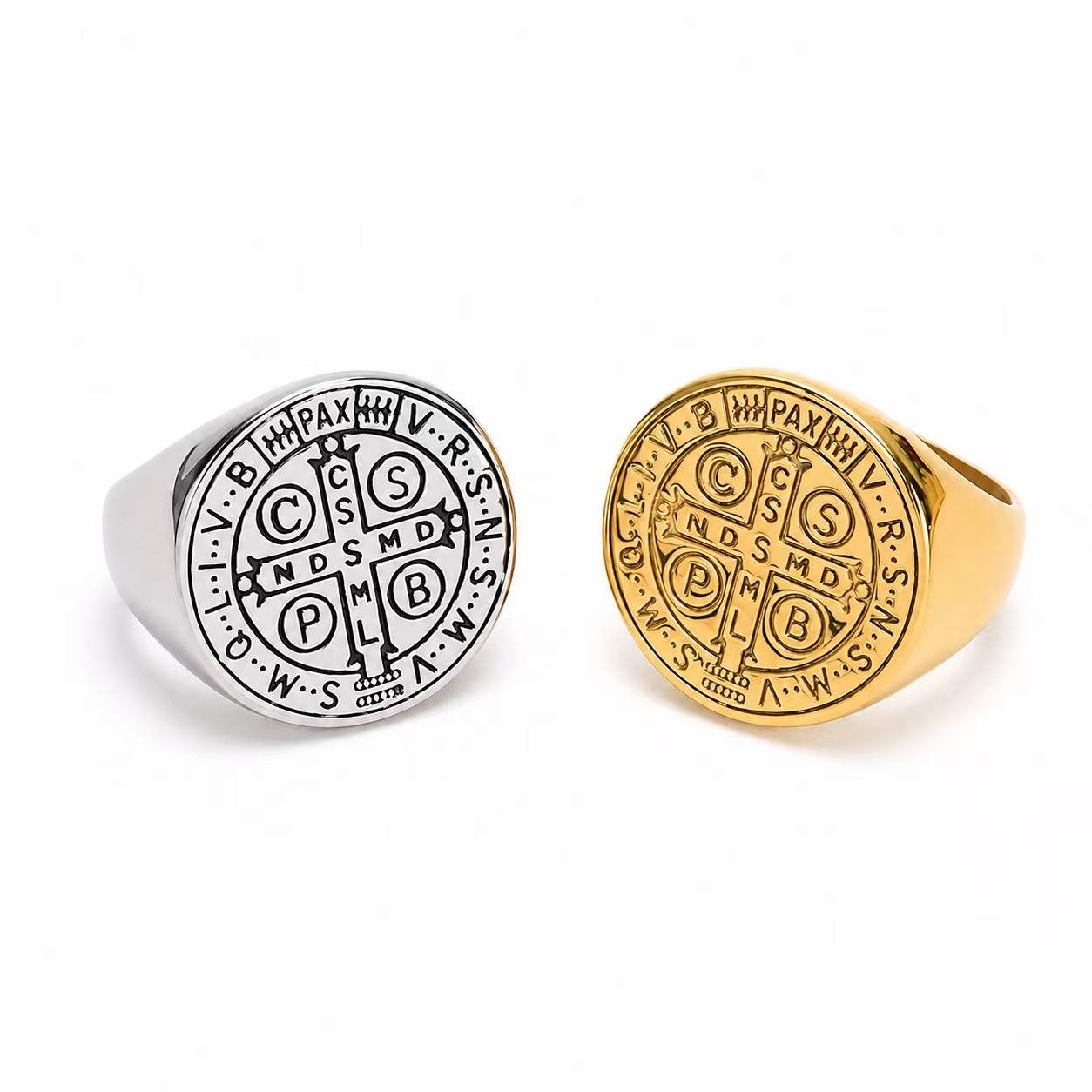
Enlarged artwork can make tiny letters look readable even when they will not remain clear after casting, polishing, oxidation and plating. Ask for a production-size rendering and a physical sample. The sample should be inspected under ordinary retail lighting, not only through a magnified factory photograph.
Use a written approval sequence:
- Confirm the intended identity and exact reference supplied by the buyer.
- Review both sides before tooling or bulk production.
- Mark which letters and borders must remain legible at finished size.
- Confirm the orientation of the medal inside any surrounding ring or cross.
- Record the relief depth and darkened or polished areas.
- Inspect the finished sample after the final surface treatment.
- Store approved photographs with a sample code and date.
Do not ask the factory to reconstruct unclear inscriptions from a compressed image. If a detail is not readable in the supplied reference, resolve it before the quotation becomes a bulk order.
Define the St. Michael Product Identity
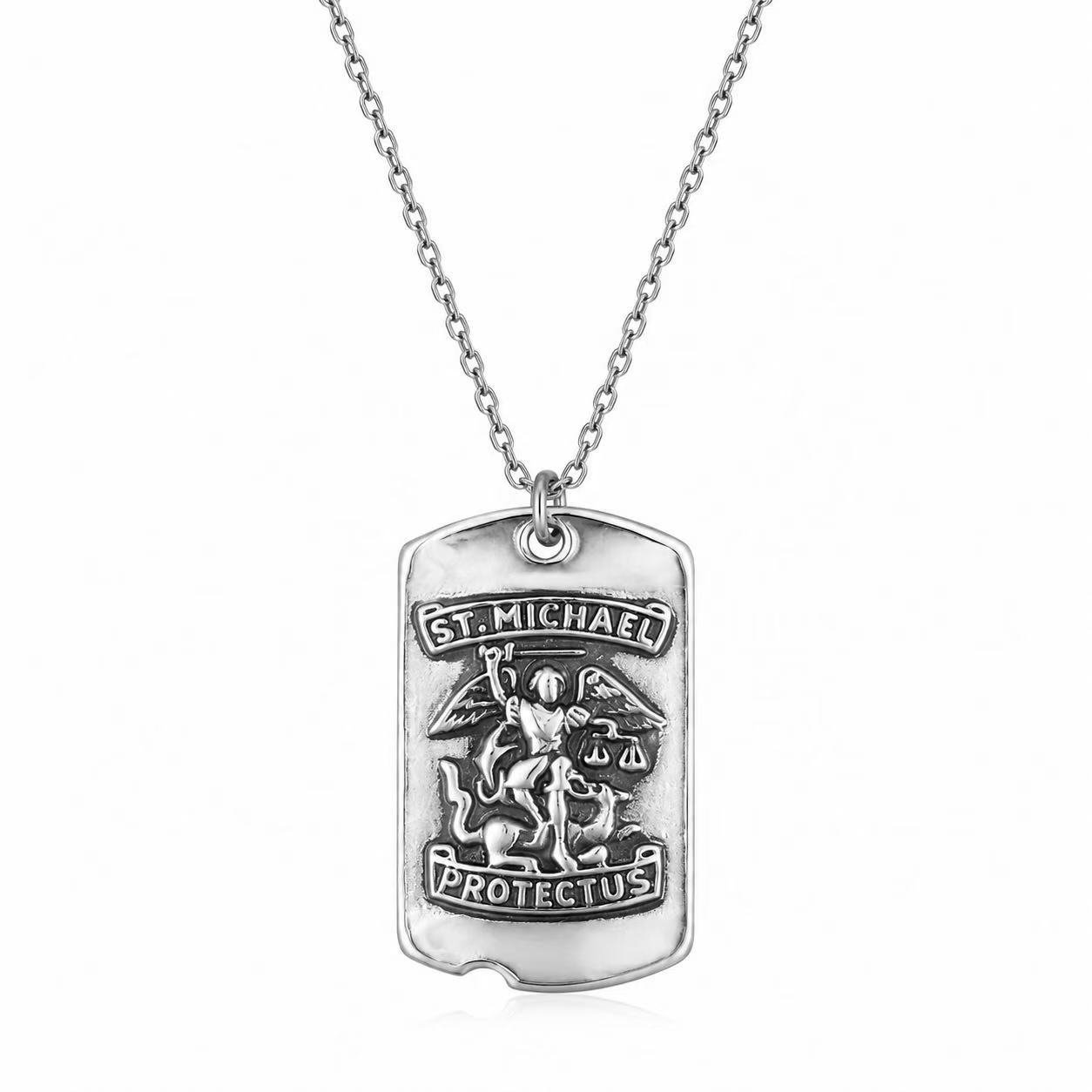
St. Michael jewelry can be presented as a medal, dog tag, ring, pendant or guardian-bell format. The product type changes the intended retail presentation and the manufacturing checks. A Catholic gift shop may prioritize a devotional pendant with clear imagery and gift packaging, while a men’s accessories or motorcycle-focused retailer may select a dog tag or bell-shaped format. The same name does not make those products commercially identical.
The St. Michael dog-tag stainless steel pendant provides a practical reference for a rectangular pendant program. Buyers should verify the figure, surrounding text, tag dimensions, edge finish, bail opening and supplied chain. The St. Michael guardian-bell pendant requires a different brief covering the bell form, relief, attachment point, dimensions and intended packaging.
Before approving a title, compare the artwork, sample and product description together. Avoid naming a figure only from an informal factory filename. When the image is ambiguous, the buyer should provide or approve the identifying reference.
Match the Product Format to the Retail Channel
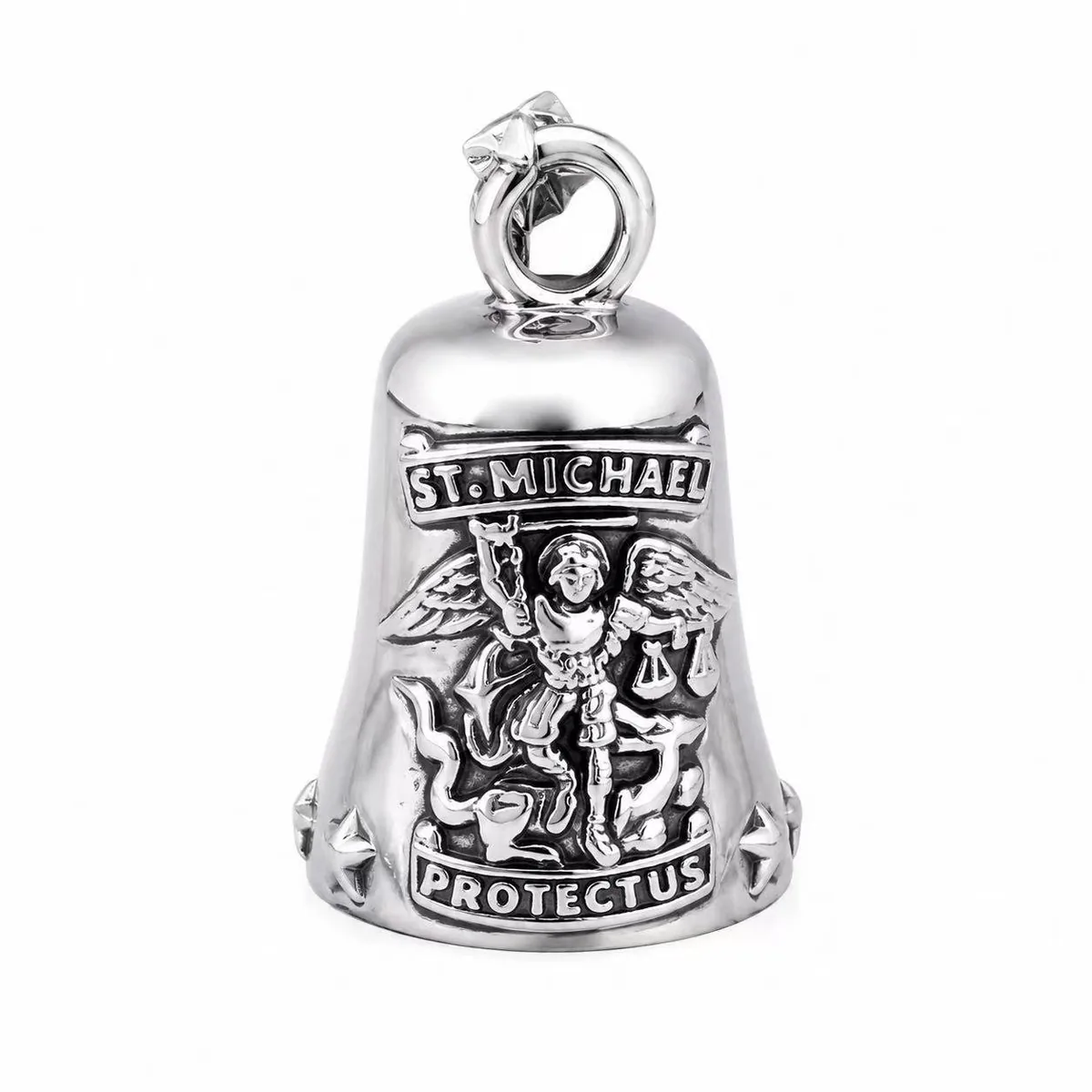
The strongest opening assortment is not necessarily the largest. Select formats that match the retailer’s customers, display space, price architecture and reorder capability.
| Retail need | St. Benedict option | St. Michael option | Buying priority |
|---|---|---|---|
| Traditional medal necklace | Two-sided medal or paired medal | Round or shaped saint medal | Front/reverse identity, chain and gift card |
| Men’s pendant program | Cross, medal or heavier necklace | Dog tag or substantial pendant | Dimensions, weight, bail and chain compatibility |
| Ring assortment | Signet, cross or detailed band | Signet or figure ring | Face size, relief, size mix and interior finish |
| Gift-focused offer | Necklace with card or box | Pendant or bell with story card | Factual copy, language and packaging assembly |
| Private-label collection | Stock design with branded packaging | Stock design or custom variation | Logo location, MOQ and approval ownership |
Use the religious rings wholesale collection to compare ring formats, and the stainless steel necklaces wholesale collection when planning chains and complete necklace offers. Keep each SKU’s identity, finish and component set explicit.
Specify Pendant, Bail and Chain as One System
A pendant can be visually correct and still fail as a finished necklace if the bail opening, chain width or end components do not fit. Specify whether the quotation includes the pendant only or a complete necklace. If a chain is included, record its material, style, length, width, clasp, jump rings and finished weight.
Ask the supplier to test the largest chain end component through the bail, not only the nominal chain width. Confirm that the pendant hangs in the intended direction and that connecting rings are closed consistently. For layered St. Benedict pieces, inspect how separate components move and whether they scratch each other during wear or shipping.
Relevant checks include:
- Bail internal width and height
- Chain link width and end-component dimensions
- Clasp type and opening operation
- Jump-ring wire thickness and closure
- Pendant balance and hanging orientation
- Metal and finish match across all components
- Finished necklace length tolerance
- Individual protection during packing
These details should appear in the approved specification and final inspection record.
Specify Stainless Steel Without Overstating Compliance
“Stainless steel Catholic medal” is not a complete material specification. State the requested grade for the main body and identify the chain, clasp, jump rings, stones, enamel or other components separately. Do not assume every connected part uses the same material or finishing process.
For each SKU, record the main-body material, construction method, dimensions, weight tolerance, surface finish and supplied components. If the buyer requires 316L stainless steel, place that requirement in the quotation and purchase order. Material naming alone does not prove finished-product compliance, so testing and documentation should follow the destination market and the buyer’s restricted-substance requirements.
Use the GZN RSL and jewelry compliance guide to plan the requested testing scope. Avoid unsupported claims such as universally “nickel free” or “hypoallergenic” unless the exact product, components, limits and evidence support the statement.
Control Relief, Oxidation and Plating
St. Benedict and St. Michael designs often depend on raised relief, recessed lettering and darkened contrast. The finishing sequence can change the appearance of these details. Heavy polishing may soften small letters; inconsistent oxidation may obscure the design; plating can collect in recesses or change edge definition.
Approve a physical finish standard for every meaningful color. Photograph the approved sample under consistent lighting and record which areas should be polished, matte, darkened or plated. For gold or black PVD variants, define the target color and gloss instead of relying on names such as “gold” or “black.” The PVD gold stainless steel jewelry guide explains additional color and batch-control questions.
Each finish creates another inventory unit and inspection requirement. Add silver, gold, black, antique or two-tone versions only when the retailer can support the quantity and maintain clear SKU control.
Build Samples Around the Highest-Risk Details
Sampling should confirm both design identity and repeatable production. Select samples that expose the greatest risk: the smallest letters, deepest relief, most complex two-sided medal, narrowest bail, widest chain end, smallest ring size and every new finish.
The approval record should include:
- Sample code and revision date
- Product identity and approved artwork version
- Actual dimensions and finished weight
- Front, reverse and side photographs
- Lettering and symbol orientation
- Relief, oxidation and plating standard
- Ring size or chain specification
- Logo, label, card and packaging version
- Deviations accepted for the sample only
When artwork, dimensions, components or finish change, issue a new version. Do not approve a revised bulk product through an isolated chat image without updating the controlled reference.
Plan a Focused Opening Assortment
A useful first order should answer a commercial question. It does not need every St. Benedict and St. Michael design available from the factory. Start with a limited set that can produce clear sales and reorder information.
One example assortment might include a St. Benedict medal necklace, one St. Benedict ring, one St. Michael dog tag and one additional St. Michael pendant or bell format. Choose one or two finishes per hero SKU, not every possible color. For rings, concentrate quantity in a controlled size mix. For necklaces, avoid creating separate chain variants unless the retail channel can track them accurately.
Separate core SKUs from test SKUs. Core SKUs should match established customer demand or the retailer’s proven price range. Test SKUs should answer one question, such as medal versus dog tag, silver versus gold finish, pendant-only versus complete necklace, or branded card versus box packaging.
Understand MOQ and Quotation Structure
There is no responsible universal MOQ for every Catholic medal jewelry project. Ready-stock products, stock designs with private-label packaging, custom engraving and new molded designs have different practical minimums. Plating batches, ring-size distribution, custom cards and the number of finishes can also affect the quotation.
Ask the supplier to separate:
- Available stock quantity and stock-product MOQ
- MOQ by design, finish and ring-size mix
- Pendant-only and complete-necklace pricing
- Logo engraving or private-label MOQ
- CAD, tooling or mold charges for new development
- Sample cost and sample delivery time
- Unit pricing by realistic quantity tier
- Packaging, barcode and labeling costs
- Testing and inspection assumptions
- Trade term, destination and freight responsibility
The OEM and ODM manufacturing service can support projects that require new artwork, dimensional changes, branded components or packaging. Send a complete brief before treating an early estimate as a final production price.
Package and Describe Catholic Products Responsibly
Packaging should protect relief details, keep components together and make each variant easy to identify. Depending on the market, labels may need the product name, SKU, finish, ring size, chain length, barcode, country-of-origin information and destination-language copy.
Keep the product description factual. State the symbol or figure shown when it has been approved, along with the material, dimensions, finish and customization options. Do not state that an ordinary factory product is blessed, church-approved or guaranteed to create a spiritual effect. A retailer may arrange a blessing or religious program separately, but that is not a standard manufacturing claim.
If a story card is included, the buyer should supply or approve the text and translation. The supplier should not invent religious explanations from unverified marketplace copy. Product photography should show the actual front, reverse, side, bail, chain and scale.
Create a Symbol-Specific QC Plan
General jewelry inspection is necessary but not sufficient for detailed Catholic medals. Combine normal surface and dimensional checks with identity-specific controls.
| QC area | St. Benedict check | St. Michael check |
|---|---|---|
| Identity | Correct medal faces and approved surrounding format | Correct figure, attributes, border and product title |
| Text | Initials, inscriptions, sequence and orientation | Approved words, spelling and placement |
| Relief | Letters and central details remain visible | Figure and attributes remain distinguishable |
| Dimensions | Medal diameter, thickness, bail and ring size | Tag, pendant or bell dimensions, bail and weight |
| Finish | Consistent polish, oxidation and plating | Consistent contrast, edges and plating coverage |
| Assembly | Medal pairing, jump rings, chain and clasp | Bail, chain, attachment point and orientation |
| Packaging | Correct SKU, card, language and variant | Correct format name, card, language and variant |
Define the inspection level, acceptable tolerances and defect examples before bulk production. Retain the approved sample for comparison. The factory tour and quality-control process provides broader production context.
Protect Artwork and Naming Accuracy in Custom Projects
For custom designs, the buyer should confirm that it has permission to reproduce any modern copyrighted artwork, brand mark, commissioned illustration or packaging design supplied to the factory. Traditional subject matter does not automatically make every modern drawing free to copy.
Specify whether the project uses an existing stock design, modifies a factory design or creates new artwork. Record ownership and permitted use of CAD files, molds, logos and packaging. Approve the final product name only after the finished sample matches the intended identity.
Buyers planning a broader custom pendant program can review the custom stainless steel pendant manufacturer guide. For cross-focused programs, use the wholesale stainless steel cross pendant guide to define cross form, bail, chain and finish requirements.
Track Reorders by Exact SKU and Variant
After launch, measure sales and remaining inventory by product family, exact design, format, size, finish and chain option. Do not combine all Catholic jewelry into one sales total. The purpose of the first order is to learn which identity and format the retailer can reorder confidently.
Use the same SKU in the quotation, purchase order, package label and sales report. At a fixed review date, classify every variant as reorder, adjust or discontinue. Share the revised mix with the supplier, including exact ring sizes, chain specifications and packaging quantities.
Reorder evidence is more useful than adding new variants without a reason. A smaller program with accurate specifications and consistent replenishment is usually easier to manage than a broad catalog with weak SKU depth.
RFQ Checklist for Catholic Medal Jewelry Wholesale
Send a structured request with the following information:
- Destination market, selling language and retail channel
- St. Benedict or St. Michael product identity
- Approved artwork or existing GZN product links
- Product format: medal, pendant, necklace, ring, dog tag or bell
- Front, reverse, lettering and orientation requirements
- Main-body and component material specifications
- Dimensions, weight, ring sizes or chain details
- Finish, relief, oxidation, stones or enamel
- Quantity by SKU, size, finish and component set
- Sample version and approval requirements
- Logo, card, box, barcode and label copy
- Testing, inspection, trade term, destination and schedule
Ask the supplier to list missing information and assumptions. A quotation based only on one small front-view image should remain preliminary.
Frequently Asked Questions
Should St. Benedict and St. Michael products use the same specification?
No. They can share material or packaging standards, but each needs its own approved identity, artwork, lettering, dimensions and QC reference.
What is the highest-risk detail on a St. Benedict medal?
The two-sided composition and small letters require close control. Review both faces, inscriptions, orientation, relief and production-size legibility after finishing.
What should buyers verify on a St. Michael pendant?
Confirm the figure, attributes, border text, product title, dimensions, relief, bail, chain compatibility and final packaging. A dog tag and guardian-bell format need separate specifications.
Can a buyer mix rings and pendants in one opening order?
Possibly, but MOQ and pricing depend on design, finish, ring-size mix, components and packaging. Request a quantity table by exact SKU instead of assuming all pieces share one MOQ.
Can the factory describe the jewelry as blessed?
Not as a normal manufacturing claim. Product copy should remain factual unless a documented religious process has occurred and the responsible organization authorizes the statement.
What information is needed for an accurate quote?
Provide the approved identity, product format, artwork, material, dimensions, finish, components, variants, quantities, samples, packaging, testing scope, destination and trade term.
Request a St. Benedict or St. Michael Collection Review
Send your selected products, destination market, quantities, ring sizes or chain requirements, finishes and packaging through the GZN quotation page. GZN can review missing production details and prepare a project-specific discussion for stock products, private-label packaging or OEM development.